CFS Institute North America Embraces Hands-On Food Safety Training
On a whiteboard table inside CFS Institute North America, a food processing facility takes shape one miniature conveyor, drain, handwashing station and hygiene zone at a time.
The food industry professionals around the table have been given two identical 3D-printed fresh-cut produce lines and a deceptively difficult assignment: Design a plant that can operate safely and efficiently today while leaving room for a third production line next year.
There is another complication. Each participant must approach the project from a different role: operations, sanitation, maintenance, plant management, project management or procurement and finance. A decision that benefits one department could create problems for another.
It’s food safety training, but it looks more like a strategy game.
In a classroom down the hall, training participants face another assignment that sounds simple: Clean a screw dipped in chocolate.
Each participant receives one tool of their choice — a wet towel, a dry sponge or a paper towel — and gets to work. But the chocolate clings stubbornly to the threads, making the tiny piece of hardware nearly impossible to clean completely.
For the engineers in the room, the exercise can change how they see every bolt, crevice and connection on a processing line.
“Those are the things that stick with people as they walk out,” said Claudia Baenen, business development manager with Commercial Food Sanitation (CFS) based in Amsterdam.
That is the idea behind nearly every detail at CFS Institute North America in New Orleans: Food safety cannot be learned from a slide deck. The lessons stick when they are seen, debated and practiced, with room to make mistakes in a controlled environment. At the facility, food industry professionals do far more than hear about hygienic design and sanitation. They experience the tradeoffs and physical demands firsthand while working through the cross-functional decisions that shape food safety and quality inside a real plant.

CFS Institute North America opened in October 2025 in New Orleans.
INSIDE THE INSTITUTE.
The relentless late-July New Orleans heat hangs over visitors like a heavy, wet curtain. But stepping inside CFS Institute North America brings immediate relief: The air is cool, and the space is bright, clean and modern, with sleek lines, open gathering areas and gleaming equipment.
The contrast is striking, but not accidental. The facility was built to make an impression, said Baenen.
“This entire facility has been purpose-built to host customers and to organize great events that leave a lasting impression,” she said. “That’s how we approach our training, and that’s how we approach any event that we host in here.”
CFS Institute North America opened in October 2025 on the New Orleans campus of Intralox, a conveyor belting and equipment manufacturer that acquired CFS in 2012. Similar CFS institutes operate in Shanghai and Amsterdam, with smaller locations in Melbourne, São Paulo and Monterrey, Mexico. The network allows global companies to send employees to training in different regions.
The New Orleans building already existed, Baenen said, but its interior was stripped and rebuilt around the needs of CFS’ training program. With three laboratories and a variety of meeting spaces and breakout rooms designed for collaboration, the result bears little resemblance to the familiar professional-development formula of rows of chairs in an airport hotel meeting room.
Inside these walls, participants attend multi-day programs covering sanitation essentials, hygienic design, advancing sanitation impact, environmental pathogen control, foreign material control and other topics.
DESIGNED TO BE REMEMBERED.
CFS trains primarily food processing professionals at both the plant and corporate levels, but classes also draw equipment manufacturers, architecture and engineering firms, and quick-service restaurant companies seeking a common food safety language with their suppliers.
Most programs are open enrollment, although companies can reserve a dedicated class for employees from multiple plants.
Attendees are typically placed into three teams before they arrive. Colleagues from the same company are separated, and CFS tries to distribute participants from quality, sanitation, engineering, operations and equipment manufacturing across the groups.
Baenen said CFS considers eight people the “magic number” for team size: small enough that every participant must contribute, but large enough to bring multiple perspectives to the exercise. The groups rotate through breakout sessions, with an element of friendly competition built in.
Even the classroom portion emphasizes participation. To introduce hygienic design, instructors present familiar kitchen tools that can be pulled apart to reveal hard-to-clean areas.
The approach is grounded in adult learning principles.
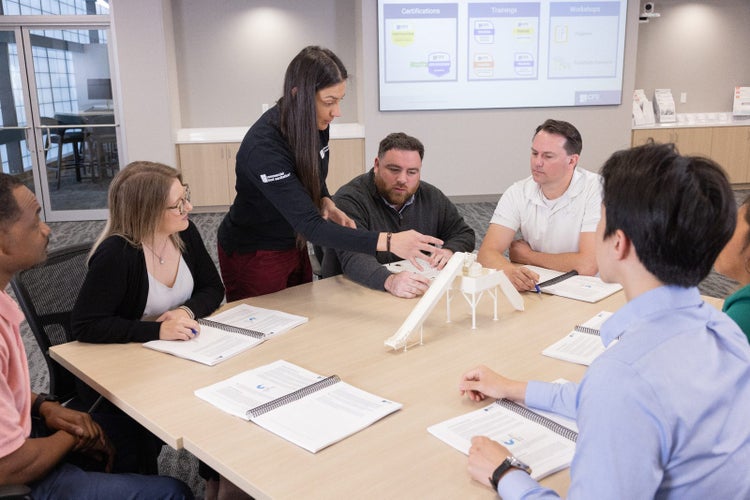
3D-printed equipment models allow training participants to construct their own facility layout.
“It helps people visualize real challenges and creates lasting memories,” Baenen said. “Weeks or even months later, they can recall that experience, apply what they learned in their own facility and share those lessons with the rest of their team.”
WEARING SOMEONE ELSE’S HAT.
Back in the breakout room with the whiteboard tables, small, 3D-printed replicas of processing equipment wait inside a cabinet for hygienic design training participants to build their own greenfield facility. CFS and Intralox colleagues designed the pieces from their knowledge of real production lines, then reproduced sets for CFS institutes around the world.
Sabina Alexander, director of technical and scientific services at QualiTru Sampling Systems, participated in CFS’ two-and-a-half-day hygienic design workshop held before the International Association for Food Protection’s (IAFP) 2026 annual meeting in New Orleans in July. With past experience in food safety, operations and environmental health and safety, Alexander was required to choose a less familiar role during training. She became the maintenance representative.
“I had to think like a maintenance person, work in terms of a maintenance person,” Alexander said. “I got to build on what I already knew, because I’ve used the checklist, I have done the inspection. But now I had to see it from somebody else’s perspective.”
Hear firsthand from Sabina Alexander on how she experienced CFS Hygienic Design Training
At IAFP 2026 in New Orleans, QA contributing editor Darin Detwiler spoke with Sabina Alexander, director of technical and scientific services at QualiTru Sampling Systems, on keeping training approachable for team members and the importance of creating connections between the industry and consumers.
As training participants assume their different roles and work to build a miniature facility, they quickly learn that a layout that works beautifully for production may create sanitation headaches. Equipment packed tightly into a room may maximize output but leave no space to disassemble, clean or maintain it. A handwashing station, drain or waste route forgotten in the first design may be much harder — and more expensive — to add later.
The whiteboards make revision painless, said Baenen. Participants can move equipment, wipe away plans that don’t work and try again. Trainers allow the teams to work, then introduce questions participants may have overlooked: What about waste flow? Can maintenance reach the line? Where will employees cross from one hygiene zone to another?
For some participants, seeing the entire system from a bird’s-eye view inspires them to create models of their own facilities so cross-functional teams can discuss current layouts and possible improvements, said Taylor Butler, a CFS food safety specialist and trainer in New Orleans.
“There are a lot of people who walk away from this saying, ‘We need to get 3D models of my facility, just to look at how it’s laid out right now versus how we can make this different or better,’” she said.
For Alexander, the role-playing exercise reinforced how easily departments can become one-dimensional when each sees only its own objective. “In hygienic design, if only one person is looking at it, it’s not going to work for your maintenance team, or it’s not going to work for your sanitation team,” she said.
The lesson will influence the technical support and training she provides QualiTru customers, Alexander said. Although she already believed in hands-on learning, she said the CFS program showed her the value of layering physical practice, discussion, group problem-solving and perspectives beyond a participant’s usual job.
“Sitting down and training is one thing, but doing that hands-on, physical doing, practicing things, working with other people, discussing the problems — it reminded me how much better training works when it’s multi-layered,” she said.
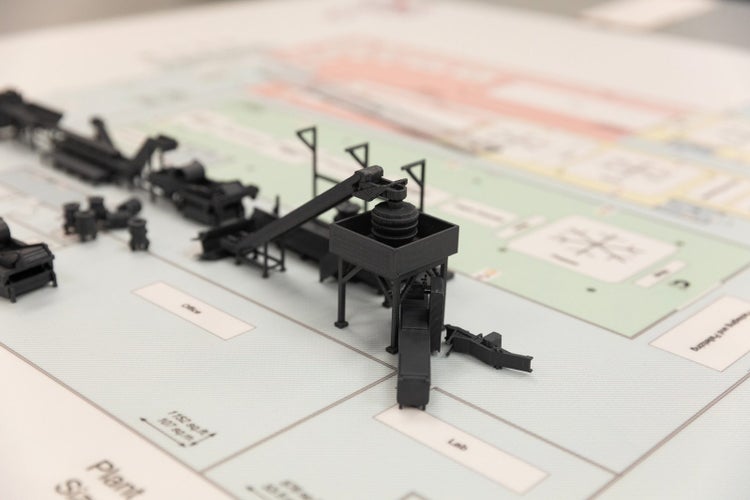
Training participants consider equipment placement as they use 3D-printed models to lay out their own greenfield food facility with hygienic design in mind.
MAKING SANITATION REAL.
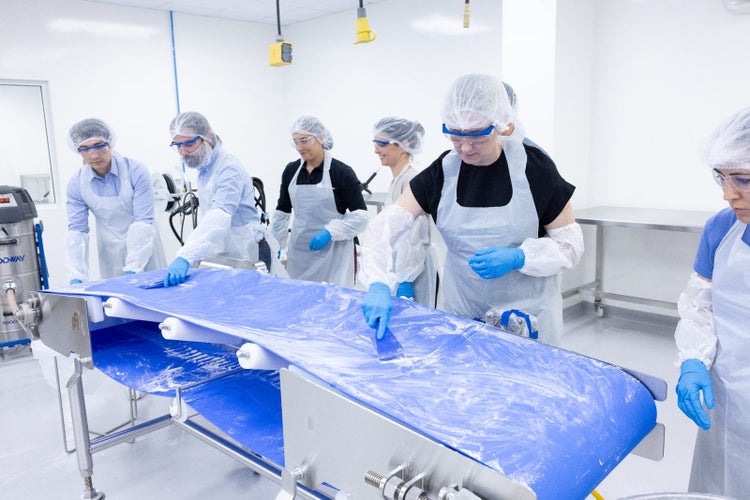
The institute’s labs are not pristine displays that trainees observe through glass. Participants don protective gear and clean the equipment themselves.
Before a sanitation breakout session, instructors soil conveyors with mixtures such as oatmeal or dough — food residues recognizable enough to approximate what attendees may encounter in a plant. Teams then apply what they learned in the classroom by completing the seven steps of sanitation. One participant, often someone who has never written a cleaning procedure, documents the work on a whiteboard as it happens.
Even experienced sanitation professionals can be tempted to jump ahead. Butler sometimes catches a participant reaching for the water hose while the team is still completing the dry-pickup step.
“We treat the steps like a staircase,” Butler said. “If you skip a step, you’re likely to trip and fall on your face or have an accident.”
Trainers complicate the scenario in ways that mirror the plant floor. A drain backs up. The team must decide whether to keep spraying or stop and manage it. Participants complete a preoperational inspection and perform ATP and allergen testing, learning that a passing ATP result does not guarantee a negative allergen result. If they find an allergen, they must decide what to reclean and whether to start again from the top.
The lab is stocked with equipment like dry steamers, foamers and a sanitizing mist system.
“We have fun in here,” said Butler. “Participants get to play with some innovative technology.”
At a Glance: CFS Institute North America
Location: New Orleans, on the Intralox campus
Opened: October 2025
Size: 13,700 square feet
Training space: Three hands-on labs, a classroom and smaller breakout rooms
Audience: Food processors, equipment manufacturers, design and engineering firms, quick-service restaurant companies and other food industry professionals
Format: Open-enrollment and dedicated company sessions; many courses use three teams rotating through three workshops
Global reach: CFS operates training institutes in New Orleans, Amsterdam and Shanghai, with smaller facilities in Melbourne, São Paulo and Monterrey, Mexico
Color-coded tools are stored on shadow boards. CFS does not prescribe one universal tool-storage system or zoning plan, Baenen said. The aim is to show possibilities and press participants to make deliberate choices, document them and apply them consistently in their food processing facilities.
“We’re showing them what good sanitation practices look like in action,” said Baenen. “When tools are cleaned, organized and color-coded, it helps reduce the risk of cross-contamination.”
The hands-on work in sanitation breakouts can be especially valuable for engineers and leaders who have watched sanitation but have not recently performed it.
“I love it when we get an engineer,” said Baenen. “Every engineer that comes to CFS Sanitation Essentials Training leaves with a different perspective. They often arrive on day one confident because they’ve seen equipment being cleaned and observed the process many times. But by the time they complete the third workshop, they start looking at equipment differently. They think about toolless disassembly, the bolts and fasteners built into their designs, and whether there is enough space around equipment for people to clean it effectively. Building that cross-functional awareness is one of the biggest goals and one of the most rewarding parts of any CFS training course.”
Even small design changes can matter. Butler offered the example of replacing a continuous piano hinge on a control panel with fewer hinges that still support the panel but create fewer niches.
“They are not capital investments, but they’re going to make a big difference,” said Butler.
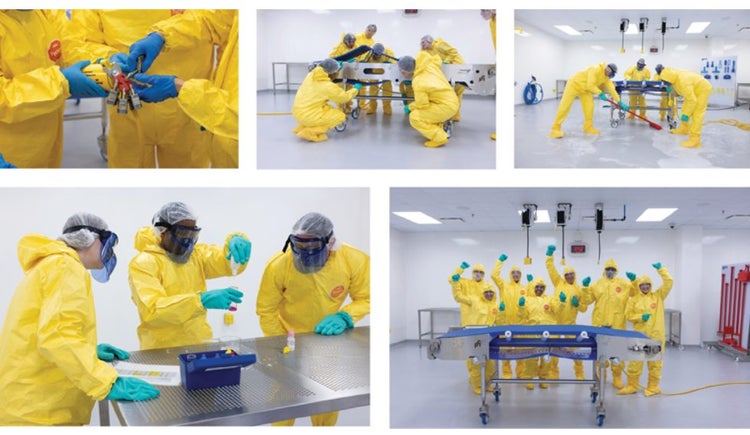
Participants suit up in protective gear for a hands-on wet-cleaning exercise.
TRAINING FOR THE PLANT THAT EXISTS.
Participants may design an imaginary greenfield plant for training purposes, but most attendees return to reality at work: aging buildings and legacy equipment they did not choose.
CFS teaches them to evaluate what they have, identify the greatest risks and distinguish between problems that can be managed and those requiring urgent correction. Participants use hygienic design checklists to assess equipment and infrastructure, then translate observations into scores that can help make the case for an investment.
“It’s easy to say, ‘Hey, this conveyor gives us issues all the time,’ but if you don’t have it in black and white, then you’re just another voice in the background,” Butler said.
A cross-functional assessment can document the risk, interim controls and modifications already attempted. It can also help a company rank competing needs. An unsealed concrete ceiling that creates condensation during sanitation may demand a different response than equipment that is difficult — but still possible — to clean.
“If it’s a ceiling that is peeling off, you may need to address that tomorrow,” said Butler. “That piece of equipment that needs replacement, you can manage through that for another year. If you need to choose, assess the risk.”
Early involvement remains ideal. CFS specialists can review proposed facilities and equipment before walls go up and changes become costly. Yet Butler emphasized that the institute’s food safety specialists regularly help companies find workable improvements under imperfect conditions.
“Our resource pool is pretty big,” Baenen said. “Our food safety specialists have seen and worked through some really challenging situations throughout their careers in the food industry. They bring that experience to every CFS training and customer engagement. Sometimes creativity is key, but because of the collective knowledge across our team, we can usually find a practical path forward and help companies improve food safety and sanitation, regardless of where they are starting.”
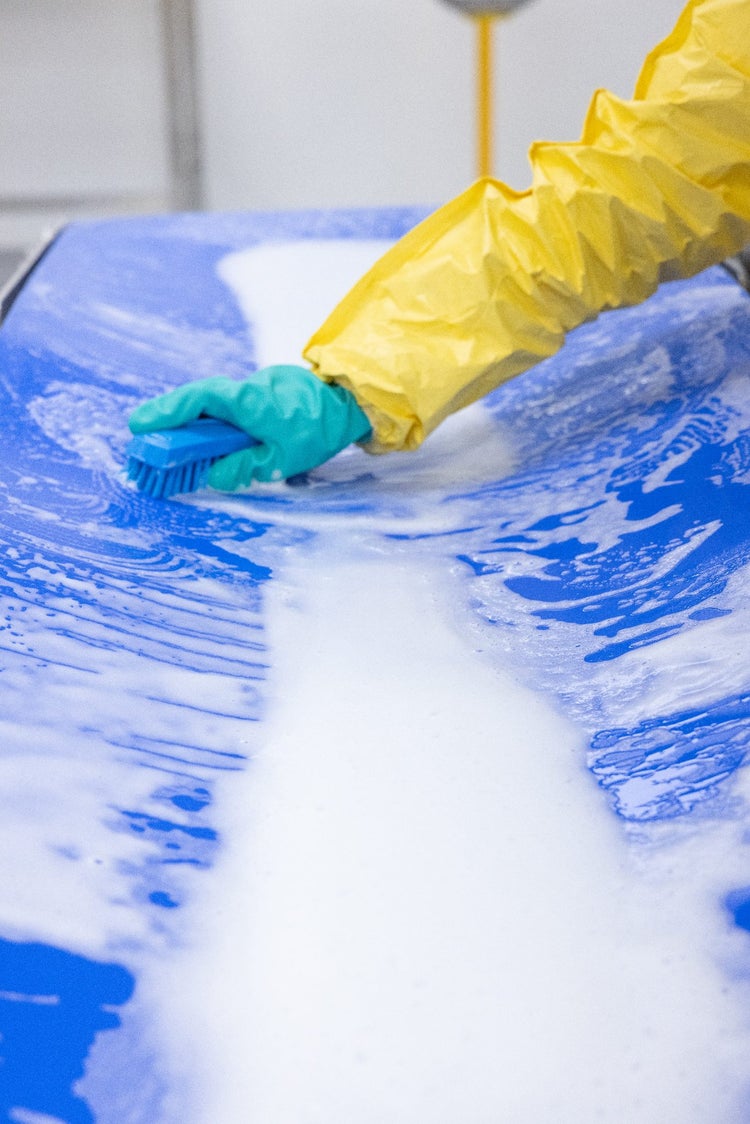
A hands-on cleaning exercise gives participants the opportunity to put sanitation techniques into practice on food processing equipment.
TAKING THE LESSON HOME.
The institute expects to conduct about 60 to 70 training sessions worldwide in 2026. Its current and forthcoming programs address sanitation essentials, hygienic design, food safety leadership, capital projects and incident investigations, among other topics.
New courses grow from the questions specialists hear in plants and classrooms; repeated requests for more detail on environmental monitoring and foreign material control, for example, led CFS to develop two new two-and-a-half-day training programs that are rolling out in New Orleans now.
CFS’ measure of success is not a certificate handed out at the door. To receive a badge of completion, participants must share something they learned at training with their colleagues within 90 days and send evidence back to the institute.
The format is flexible. Some deliver presentations covering all three workshops. Others rewrite a cleaning procedure, introduce color-coded tools or focus on one attainable design improvement — such as reducing the number of piano hinges in the facility.
The requirement serves two purposes: It spreads the knowledge beyond the employees who attended, and it asks them to use the material before it fades, said Baenen.
“Change is happening one person at a time,” she said.


