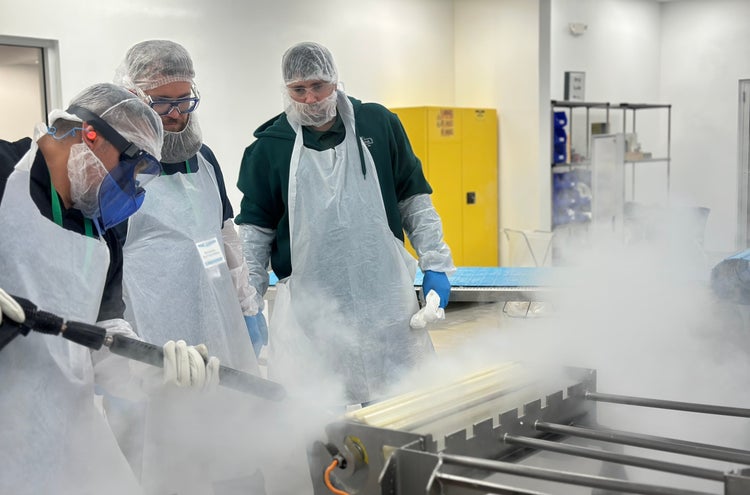
Global food companies need to keep their factories clean and safe. They learn how in Harahan.
Staff photo by Sophia Germer, The Times-Picayune
In food manufacturing, a poorly maintained facility can lead to tragedy. Last year, there were nearly 300 food recalls related to 19 deaths and almost 500 hospitalizations in the U.S. A listeria outbreak traced to a single deli meat plant in Virginia caused 10 deaths and dozens of illnesses.
The problems ranged from cucumbers contaminated with salmonella to products containing undeclared allergens like peanuts or tree nuts.
It's these types of situations, including products coming off store shelves this month, that the trainers at Commercial Food Sanitation hope to prevent.
The company, known as CFS, is a subsidiary of New Orleans-based manufacturing behemoth lntralox, which has a reason to take food safety seriously. lntralox's primary business is designing and building conveyor belts, and it sells them to roughly 80% of the world's most well-known food companies. lntralox CEO Killian Lapeyre said his customers need this training, and showing them how to operate their production lines safely makes business sense.
"It's critical for us to be a leader in the space," Lapeyre said.
CFS has grown from a single employee in 2012 to a 40-person team of food manufacturing veterans with offices in Europe, Asia, Australia and South America. On Friday, the company celebrated the opening of a new U.S. headquarters in Harahan.
The 13, 700-square-foot, $6.3 million facility includes classrooms, labs and administrative space where companies will send executives and employees to learn from CFS how to keep their food production as safe as possible.
On the hunt for harmful bacteria
CFS food safety specialist Taylor Butler, who grew up on the West Bank and lives in Chalmette, worked at a chicken plant in Texas, then at a catering vendor for United Airlines and a cheesecake manufacturing factory.
Now she spends about two weeks each month visiting food production facilities around the country, helping them find and fix problems. A third week often is spent leading training sessions at the lntralox headquarters in Harahan.
In the field, Butler teaches food executives about environmental monitoring, sanitation, hygienic design and good manufacturing practices. Part of the process is swabbing areas in facilities to look for listeria, salmonella and other dangerous bacteria.
"It's all around us, in the air and the soil," she said of bacteria. "But if you give it food, moisture and a place to live, it will thrive."
Staff photo by Sophia Germer, The Times-Picayune
Butler makes sure facilities have barriers in place to stop contamination. That could be antibacterial powders applied to footwear and hand sanitizing stations, or physical obstacles like walls and lines painted on floors that demarcate different parts of the factory.
"You have to have hygienic zoning when you lay out a facility, separating raw areas from ready-to eat areas, non-production from production," Butler said.
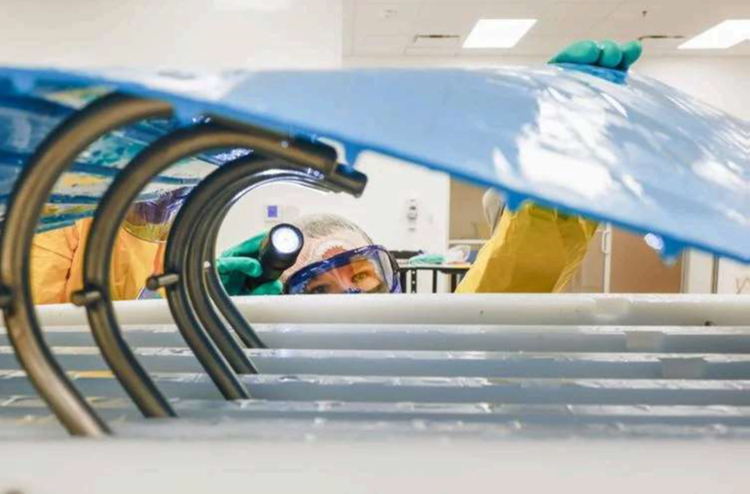
A major area of focus is identifying and removing "niche points," places in a manufacturing plant where bacteria can collect, which sometimes requires some detective work.
Butler visited a site recently where employees had been finding evidence of bacteria but couldn't find the source. "The equipment was poorly designed, so there were pieces that were difficult to take apart," Butler said. "Once we took off a belt and other components and looked more deeply, we found a little surprise. As these conveyors run, they shake a little, and these niche points start leaching out."
CFS might tell customers about lntralox products that could help solve problems, including the company's FoodSafe line of conveyor belts, tools and components. But they try to avoid turning the training into "infomercials" for their parent company, officials said.
'Cleaning camp' in New Orleans
Butler and other CFS trainers bring that training to Harahan about 30 times each year. Their counterparts do similar work in the Netherlands, Brazil, China, Australia and Mexico. In total, the company has hosted more than 5,000 trainees, which include food brand executives, equipment manufacturers, plant engineers and sanitation supervisors.
Staff photo by Sophia Germer, The Times-Picayune
Until last month, the class activities in Harahan were scattered across a sprawling 1 million-square
foot campus supporting the manufacturing and marketing of products for lntralox and its parent company Laitram. With the opening of the new CFS headquarters, overseen by CFS Global Training Manager Nicole Cammarata, that work has been consolidated into a space that resembles a hotel lobby and conference center.
The training sessions combine learning with the perks of a New Orleans vacation. Participants are shuttled back and forth from downtown hotels and restaurants to their sessions in classrooms and labs. In one of those labs, instructors dab equipment with a special gel that glows under UV light. Trainees are graded on their ability to locate all these strategically hidden "germs."
In another space, trainers demonstrate how to use dry steam, a type of low-moisture vapor to remove dirt, grime, and bacteria from various surfaces. This type of cleaning is used in bakeries to prevent growth of mold and bacteria.
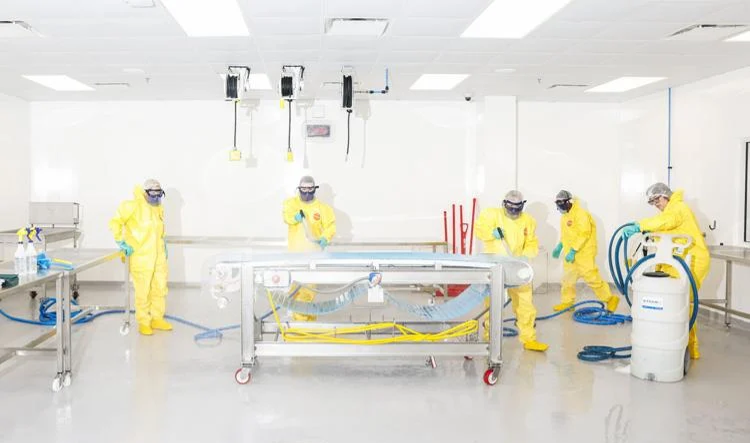
A separate room is equipped with hoses and drains so trainees, wearing bright yellow protective suits and goggles, can learn how to remove vegetable shortening and other hard-to-clean substances from equipment. The hope is that the experience will teach company leaders how to design and set up machinery to make it easier for their employees to keep their facilities safe, said CFS General Manager Darin Zehr.

Staff photo by Sophia Germer, The Times-Picayune
Conveyor belts are booming
The new CFS facility is a small part of one of the biggest manufacturing businesses in the state. lntralox is a $1 billion-plus annual enterprise on pace to set another revenue record this year.
The company makes hundreds of different types of conveyor belts, designed to move everything from food through ovens to cars along assembly lines. It sells high-tech sorting machines for logistics customers like Amazon, and it provides systems that keep contaminants out of the water used to cool nuclear power plants. "We move everything from people to potato chips," lntralox communications chief Karyn Kearney
said.
The company is by far the biggest subsidiary of Laitram, the 76-year-old operation that also makes industrial stairs, shrimp-peeling machines and other equipment. Overall, Laitram and lntralox employ about 4,000 people worldwide. Roughly half of those are in Harahan and at a growing facility in Hammond.
All the company's modular conveyor belt components are manufactured in Louisiana and shipped around the world for assembly.
lntralox's food manufacturing customers were the inspiration for the acquisition of Commercial Food Sanitation, which came in 2012, after passage of the federal Food Safety Modernization Act. That Obama-era legislation increased regulations designed to prevent foodborne illnesses.
The increased scrutiny came along with innovations like DNA sequencing of bacteria, which can help match sick people to the source of the food that made them ill, and traceability programs, which allow regulators to avoid overly broad recalls.
Food safety training is another way to try to prevent more deadly lapses.
"Our team is good at making people understand these problems are real," Lapeyre said. "It's easy to brush things off and say there's a one in a million chance of a problem happening, but for a big food company, one in a million could still equal many times a year."